
This month, I took a home fertility test. Sounds a little strange doesn’t it? Fertility isn’t something we often discuss until it’s too late, and it’s something often taken for granted. Unless you’ve had menstrual cycle problems or other health issues, your fertility probably hasn’t even crossed your mind. But I think it’s something we could all pay some more attention to.
Why should you learn more about your fertility?
To put it simply, it’s good to learn more about your body, whether you’re trying to conceive or not. If you are trying to conceive, the reasons for understanding your fertility are obvious. Think of it like this, you don’t really like getting your period, but you’d still be concerned if it didn’t show up for some unknown reason. And you’re happy, even if you’re not consciously thinking about it, when it shows up on time and everything is going as expected. It’s good to know what you’re dealing with.
The average age for a woman in the UK to have their first child is 28* (28.8 actually), that’s up from 24 in the 1970s*. As of 2016, there are now more women who have children over 40 than under 20*. If you choose to have children slightly later, being aware of your fertility when you’re younger, and what’s normal for your body, can help prevent complications down the road.
My Fertility Test
As I said, I took a fertility test. The one I took detects raised levels of Follicle Stimulating Hormone (FSH) in your urine. This is one indication of low ovarian reserve. I’m very glad I read the instructions twice because a positive result can be an indication of reduced fertility. Before reading the instructions, I would have assumed positive was a positive sign of fertility.
Two lines on the test means you got a positive result and indicates that your FSH levels are high, which can be a sign of reduced fertility. One line (a negative result) on the tests means your FSH levels are not raised, which is a good indication of fertility. As you can see, I got one line, which suggests I am fertile.
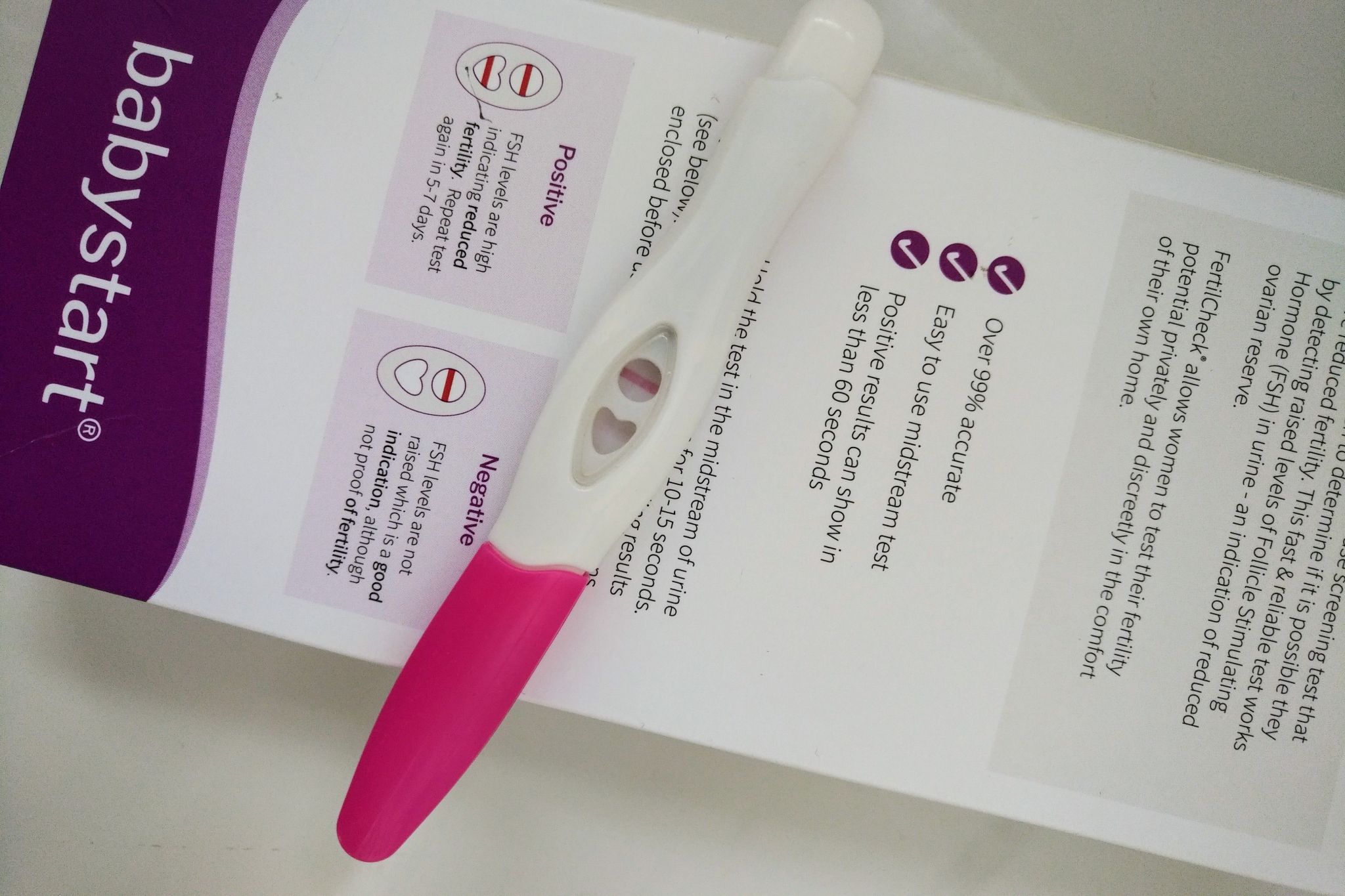
One line, which is a negative result. And a positive indicator of fertility.
These tests cost just under £10 for a pack of 2, £5 for indication of your fertility potential sounded very reasonable to me.

Ovulation
There are several ways to track your cycle and try to understand when you are ovulating.
I track my cycle using an app, so I know roughly when I should be ovulating and look out for symptoms around that time. If you were actively trying to conceive, you can also buy ovulation tests to double check.
I’ve used the Clue app for around 3 years now. I like this one because it asks you for information about your last 3 cycles when you sign up and adjusts your predictions over time when you start inputting data. This is particularly helpful for me as I have a slightly longer cycle, it tells me I ovulate around day 21 rather than assuming it’s day 14. The app also allows you to add your basal body temperature (BBT) if you track that at home, so it can suggest if there’s a chance you’re ovulating earlier or later than expected one month. Of course, if you’re not adding a temperature, this is all based on averages and less reliable.
Symptoms of ovulation
Not all women experience symptoms when they ovulate, but there’s a few things to look out for if you are trying to predict when you are ovulating.
Symptoms of ovulation:
- Cervical mucus changes to be an egg white texture
- Increase in BBT
- Breast tenderness
- Pelvic/ lower abdominal pain
- Bloating
Irregular Cycles and Fertility
Once upon a time, I had the most regular cycle ever. Then, seemingly overnight, I didn’t. My period used to arrive every 5 weeks to the point I could tell you almost to the hour when it would begin. Then they would come every 5 weeks, every 7 weeks and…whenever it felt like appearing. I just opened my app, in the last 12 months my cycle length has ranged from 34-57 days. My gynecologist has told me in the past that this level of irregularity could mean I’m not ovulating properly. While I’m not too bothered about when I’m ovulating or on my period, I’d still like to know that everything is running smoothly. Which is one of the reasons I wanted to take the test to begin with.
It’s important that any changes to your cycle are discussed with your doctor.
If you’re trying to track your cycles and predict when you are ovulating by using only an app, that could be tricky if you have irregular periods. This is especially challenging if you’re trying to conceive, and you might want to invest in something that tracks and stores your data for you.

Alternative Tracking Methods
How you track your cycles can vary massively in cost and effort. Using an app to record your data is free, but you might be looking for something to do the hard bit for you, such as a fertility monitor. A fertility monitor is an electronic device that helps you to track your cycle to learn more about your body and when you are fertile, such as Daysy which is available from Dr Fertility.
Daysy uses your BBT to let you know when you are in your fertile window and when you are not. This means you can use Daysy when planning a pregnancy. If you are not trying to get pregnant, on your fertile days you can use a barrier method of contraception. It also predicts when you’re ovulating, tells you when your period is due and can tell you when you’re pregnant. She’s pricey but has an average life span of 7 years, so she can help you track your cycles, conceive more than once and keep you informed about your cycle in-between. You just have to remember to use Daysy to take your temperature every morning as soon as you wake up, even before you get out of bed. Perfect for anyone who’s busy or might forget to check in with themselves.
That’s a little advanced for where I’m at with my needs right now, but I can certainly see the benefit for anyone who is looking to pay very close attention to their cycles. Of course, the tests don’t tell you everything and you should see your doctor if you have any concerns.

I’m really curious about this, have you ever seriously thought about your fertility? Especially those of your around my age, or perhaps younger. Would you be tempted to take a test to find out?
Until next time,
Sophie
*All Statistics sourced from the Office for National Statistics
This post is a paid partnership with Dr. Fertility.
This is the last ‘This Month’ that will be appearing on this blog! Check out its new home here.
Never ever heard of fertility tests, they sound super interesting! I’d be super tempted to try these cause this kinda stuff interests me!
Oh I know all about these. I was trying for a baby for 5 years with my partner and was told I could never conceive due to my many issues but now we’re expecting and it’s a miracle! It’s good to always check your fertility even if you aren’t trying just so you know what’s going on with your body
Love Lozza xo
http://girlygabble.com
I’d definitely be tempted to take a test! I’ve had a few issues in the past with my cycles and I’m not hopeful things will be straight forward when it comes to actually planning and having children in the future so I think things like this are worth thinking about. I wish I saw more blog posts like this, so interesting to hear your thoughts on fertility xx
Tiffany x http://www.foodandotherloves.co.uk
This post has honestly taught me so much. I’ve never really educated myself that much on periods, to be honest I think it’s because they’ve always been such a huge hindrance for me from pain to heaviness to irregularity that I try to keep them out of my mind as much as I can. This post really suggests that I should’ve been doing the opposite, really. I’ve never worried about my fertility, partly because becoming a mum has always been a take it or leave it thing for me. If I got pregnant then I’d happily nurture, love and raise a child but I’d be equally as happy living my life without doing so as I’ve always been a pretty independent person who finds happiness and contentedness in a huge variety of things. Saying that, after all of the period-related issues I’ve had, I would be really interested to know about my fertility. Especially as I know quite a few people who have had abortions or pregnancy scares and I never have, despite finding out that my pill was likely to be inactive during my 18 months of severe illness (AFTER my surgery, someone really could’ve told me).
Alice Xx
I’ve actually thought about my fertility pretty frequently as I’ve grown up. One of my biggest fears is that I won’t be able to have children, so although I’ve never had any reason to worry that that might be the case, it still crosses my mind. I am so so glad you wrote this post–too often, fertility is something that a lot of us overlook in this modern age where childbearing has been pushed back and many women pursue professional goals over family goals (which is totally fine of course). I think it’s important to always keep this in mind, so even if you want to do your own thing for a decade or two, you’re always aware of where your body is especially if children are in your plans. Loved this!!
Wow I’m surprised the average age for a first baby is 28! I’m 25 – almost 26 and feel like most of my peers have already had children. I found this post really interesting because I definitely want children and sometimes worry that when it comes to it I may have problems. I don’t really have any legitimate reason to feel this way I just worry – silly I know. These would be really helpful though!
Hayley | hayleyxmartin
Thats really interesting! I’m nearly 25 and I only have one friend who’s had a baby so far. I actually thought 28 was younger than I was expecting! It’s worth looking into if you’re concerned! Thanks for reading x
I’ve never really sat and thought about fertility because I’m on the pill I’m actively stopping my body from thinking about babies but because I’ve been on the pill for a few years I’m definitely interested in what it would say! I may have to try this out x
I didn’t realise the average age for a first time mum was 28! I thought it was much earlier than this (early 20s). Tempted to try a test out of curiosity. Informative post x
It is important to understand how your body functions. If there is science to support it, do it! It’s great that you took a fertility test, big plus that they are super affordable. I have irregular cycles and should look into this. Thanks for sharing your experience with the fertility test!
Nancy ♥ exquisitely.me
I think it’s a good idea to check your fertility, that way you can plan for your future a bit better, especially if there is a problem xx
Lucy | http://www.lucymary.co.uk
I’m currently 19, turning 20 in the second half of the year and I’ve always thought that I’m too young to be thinking about my fertility but you’re right, if I track it now and notice any abnormalities, I can get answers and help which could prevent future complications. This is definitely something I am going to looo into it, it’s important even if I’m not currently trying for a baby
Fran
This is such an interesting post to read and I completely believe that people should look at their fertility more. I got diagnosed with PCOS at 21 so I’ve known since then (2/3 years ago now) that my fertility is not 100%. It’s something that I worry about every day as I want to be a mum one day but the only positive I can take from finding out so young is that when the time comes to wanting children, I can go straight to my doctor to get the necessary treatment needed to hopefully help me conceive naturally. Those kits look so useful and a little bit confusing haha! Liz x
I honestly had no idea that you could even get a fertility test so easily and cheaply- I suppose that shows you just how much I’ve considered it. Right now I feel like a lot of people around me are thinking about or having children so it’s so nice to hear that the average age is 28 because I’m so not ready! This is super interesting though, I’m intrigued!
Soph – https://sophhearts.com x
Honestly, I didn’t know you could get at home tests either until I spoke to the people at Dr Fertility. I knew you could get fancy devices like the Daysy but I didn’t know there were affordable options like this. My first thought when I read 28 was for every 16 & pregnant, there’s a 40 year old woman. Really helped put that number into perspective. Thanks for reading x
I had never heard of fertility tests. I would have been open to using one if when I was thinking about getting pregnant. That was years ago now!!!
Wow this is such a good idea to check! Thanks for sharing!
xx- Nina
I personally never want to have children so my fertility isn’t something I’m concerned about but I’m glad that there are at home options to try out x
http://www.ofbeautyandnothingness.co.uk
I’m on the mini pill right now so I’m not sure whether taking a fertility test would even work on me? I’ve never even considered fertility. I always assumed because I’ve had fairly regular periods that I must be fertile but I guess you never know, especially as you get older and your body changes.
Jenny
http://www.jennyinneverland.com
I genuinely didn’t even know you could get these kind of tests! But even though I’m not thinking of kids at this point, I think it is important to be aware of the situation and what could be further down the line for you. I think I’ll have a look into these, just out of curiosity!
Thanks for sharing!
Rhianna x
This is so interesting, I never knew you could do an at home test for this sort of thing! And it’s so affordable, and so handy! xx
Em // http://www.emilybecca.com
Oooh I’ve never heard of these fertility tests, but these look amazing!
Love, Amie ❤
The Curvaceous Vegan
AMAZING topic to talk about ! loved this!
This is such an informative post. It has taught me so much! I have six children, but as i a sufferer of polysystic overies there were times i worried if i would even have one. After my fourth babt my body corrected itsrlf and now my periods are like clockwork.
This is such an important topic that most women gloss over entirely. I know that until I was dealing with an issue with my gynecological health in my early 20s, I had never put any thought into it!
Oh wow, I love how easy it is to check fertility nowadays! I’ll definitely have to look into this because I’ve always been so curious about mine. Thanks for sharing!
☼ cabin twenty-four
This was really interesting to read, I haven’t really thought much about my fertility, I haven’t looked into periods too much, I usually just hate them because of how annoying and painful they are aha. It doesn’t surprise me too much that the average for a woman to have a baby is at 28 now, a lot of people nowadays have children later on – I would like children myself, and I am 25 this year but I am most definitely not ready for children yet!
Chloe xx
http://www.chloechats.com
This may seem like a lazy comment but I really love topics like this that focus on taboo topics. Thanks for sharing.
I honestly had no idea home fertility tests were available. This is a great idea and something I may use, not because I’m planning to a baby, but I think it’s important to see how your bodies working. To check things are OK so you can speak with a health care professional if things seem ‘off’. Thanks for sharing such an informative post Sophie. I look forward to reading more in your new blog.
I was really surprised that because of this I looked up the average age in the US and it was a lot higher than I assumed it would be, but I also looked at the average age in my city and it was 22 which still sounded to high to me lol. Fertility test is probably something I should look into since I don’t want children, but I do track my ovulation because it comes with a period tracker app I have.
I didn’t know these kind of tests were available at home. Really informative post! xx
Violethollow.com